Огонь VPN
- 4.7
- Rating
- 10.00M
- Installs
- Free
- Price

 Analysis by App-foxy
When I test a VPN, I pay less attention to the promise of speed and more attention to what happens when the connection is awkward: a weak mobile signal, a crowded public network, or a service that needs to reconnect at exactly the wrong moment. That is the angle I took with Огонь VPN, a free tools app from F2P. It presents itself as a straightforward way to reach the internet through a VPN connection, and that simplicity is both its most appealing quality and the main reason some users may want something more advanced.
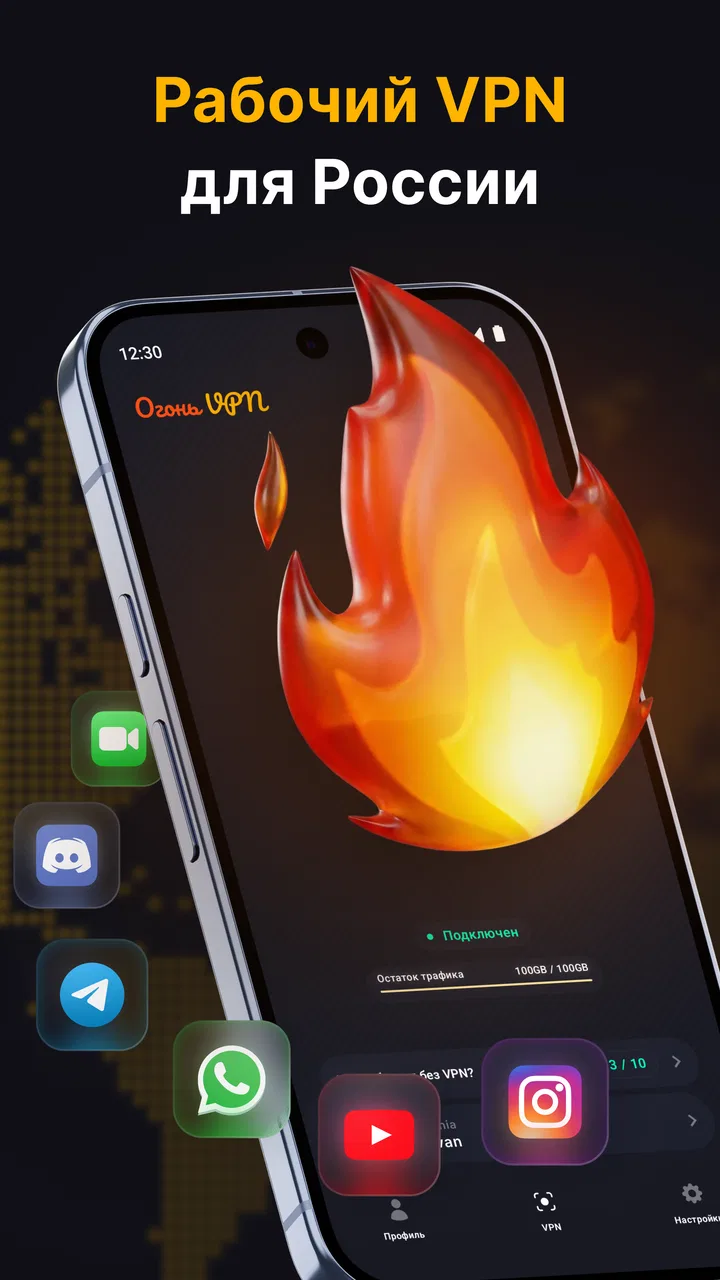
The app is aimed at people who do not want to spend time comparing complicated settings. Its store summary describes it as a simple, fast service for free internet access, while the short description is the brief Russian phrase “Огонь VPN.” In practical terms, I would place it in the quick-access end of the VPN category: something you open when you need a connection route changed, rather than a full privacy toolkit that you configure in detail before every session.
It is free to install and carries an Everyone age rating, which makes the first step easy for a wide range of users. The current version is 0.84, and the app requires Android 8.1 or later. That Android requirement is worth checking before downloading, especially if you are trying to revive an older phone for travel or as a spare device.
You May Also Like

 Blood Strike: 2.5 Anniversary
Blood Strike’s Loadouts Turn Every Drop Into a Tactical Gamble
A close look at Blood Strike’s custom loadouts: how fast access to signature weapons reshapes its battle royale rhythm, rewards preparation, and narrows the gap between fights.

 Pandora - Music & Podcasts
Pandora’s Music Is Easy to Start, but Harder to Recover
Pandora’s strength is its low-effort path from a seed to a station. Its weak spot is how much confidence it asks you to place in connection, setup, and quiet recovery.

 8 Ball Pool
 Is Built on Rivalries, Rematches, and Routine
A close look at the rivalries, rematches, shared routines, and unanswered safety questions that turn a quick pool match into a persistent mobile community.

 Samsung Music
’s Quiet Strength Is Playing What You Already Own
Its reach comes less from spectacle than from dependable access to a personal library. That simplicity is both the app’s strongest retention engine and its ceiling.

 AccuWeather: Weather Radar
AccuWeather Review: A Quick, Clear Forecast for Everyday Decisions
For everyday plans, the best forecast is the one you can understand quickly. AccuWeather makes rain timing, radar, and local conditions easy to act on, with a few trade-offs.

 Hill Climb Racing
Why Hill Climb Racing Still Turns Crashes Into One More Run
A tiny car, a bumpy hill and one more upgrade: Hill Climb Racing keeps resurfacing because its simple chaos makes every near-miss feel personal.
More From Our News Desk



How the connection changes everyday use
I find that a VPN’s real value shows up after the connection is switched on: the next step might be opening a booking page, checking a message, or moving from public Wi-Fi back to cellular data. I’d judge the experience by whether that handoff stays understandable, not just whether the app connects once. That practical lens also makes it easier to spot when a slow result comes from the network rather than the VPN.
What happens during network-dependent moments
A VPN is only useful when the phone can already reach the internet in some form. That sounds obvious, but it matters with an app built around quick access. If your mobile signal has disappeared completely, turning on a VPN cannot create a connection from nothing. Fire VPN is therefore most relevant when the network is available but you want to use a different route, or when a public Wi-Fi connection feels like a place where you would rather add another layer between your phone and the websites you visit.
In my experience, the most sensible everyday scenario is a short stop at a café, airport, hotel, or shared workspace. I connect to the available Wi-Fi, open the VPN, wait for the connection to become active, and then do ordinary browsing or messaging. The useful part is not that the app transforms a poor signal into a strong one. The useful part is that it gives me a simple step between joining the network and starting tasks that involve accounts or personal browsing.
That distinction also helps set expectations about speed. A VPN can add processing and routing overhead, so “fast” should be treated as a goal rather than a guarantee in every location. The final experience depends on the phone, the local network, congestion, and the route being used. I would not choose this app solely because I need the lowest possible delay for competitive gaming, a live video call, or a large upload. For those situations, the ordinary connection may be better if privacy and routing are not the priority.
There is another practical issue: a VPN connection can look active while the underlying Wi-Fi is unstable. If a page stalls, I first check whether the Wi-Fi itself is still working before blaming the app. This small habit saves time. Disconnecting and reconnecting the VPN repeatedly will not fix a router that has lost internet access, and it can make the recovery process feel more confusing than it needs to be.
Using it on a moving phone
Mobile use is where a lightweight VPN can make the most sense. People move between cellular data and Wi-Fi throughout the day, often without noticing the exact moment the handoff happens. A connection that was fine in one place may become slow or unavailable a few minutes later. With a VPN active, the app has to maintain its route while the phone changes networks, and that is a more demanding situation than simply connecting once at home.
I recommend treating the app as a tool for specific stretches of activity rather than assuming it should remain enabled forever. If I am checking a few websites on public Wi-Fi, I can turn it on for that session and turn it off when I leave. This keeps the workflow clear and avoids wondering later whether a slow connection is caused by the VPN, the network, or the phone’s own signal.
On a commute, I would be especially careful. Trains, buses, and cars pass through areas where the signal changes quickly. A VPN cannot prevent the normal interruptions caused by moving between cellular towers or losing coverage in a tunnel. If an important task depends on uninterrupted access, I would finish it before entering a weak-signal area rather than relying on any VPN to preserve it.
The same advice applies to calls and live media. A VPN may be perfectly reasonable for reading, shopping, or checking messages, but a real-time activity is less forgiving of changing latency. If a call becomes choppy after activation, the practical test is simple: disconnect the VPN briefly and compare the connection. If the call immediately improves, the trade-off is clear. If it does not, the local network is probably the bigger problem.
For users with limited mobile data, this distinction becomes even more important. A VPN does not make web pages smaller by itself. It changes the route; it does not automatically turn a data-heavy video, image feed, or app update into a light one. I would avoid leaving it active during long streaming sessions on cellular data unless I had a specific reason to do so and enough allowance to cover the content itself.
Recovering when the connection fails
The most useful VPN habit is knowing how to recover without guessing. When a page refuses to load, I use a short sequence: check whether another website works, switch between Wi-Fi and cellular data if possible, disconnect the VPN, then try activating it again. This separates a general internet failure from a VPN connection problem. It also prevents the common mistake of changing several things at once and losing track of what fixed the issue.
If the app does not connect promptly, I would not keep tapping the activation control over and over. Repeated attempts can create a frustrating loop, especially when the phone is already dealing with weak Wi-Fi. Waiting briefly, closing the connection cleanly, and trying once more is usually a more sensible workflow. If ordinary browsing works with the VPN disabled but not when it is enabled, that is a strong sign that the current route is not suitable for that moment.
Battery-conscious users should also pay attention to recovery behavior. Any active network tunnel can involve ongoing background work, and a phone that is already low on power may not be the right place for extended troubleshooting. My approach is to use the VPN for the task that needs it, then disconnect it when the task is finished. That is not a criticism unique to this app; it is simply a practical way to keep control of a network tool on a mobile device.
Restarting the phone should be a later step, not the first response. Before doing that, I check the basic conditions: is the device actually online, is the Wi-Fi login page still waiting for approval, and does the problem affect every app or only one? Public networks sometimes require a browser sign-in before they allow normal traffic. A VPN can complicate that initial login, so connecting to the Wi-Fi first, completing its access screen, and only then starting the VPN is a useful order of operations.
This is one of the more important trade-offs for a simple VPN. Fewer visible decisions make the app approachable, but they also leave the user with fewer ways to diagnose a difficult connection. If you want detailed server selection, protocol controls, or extensive troubleshooting information, a more advanced VPN service may be a better fit. If you prefer not to manage those choices, Fire VPN’s simpler approach can feel less intimidating.
Keeping mobile data use under control
Because the app is free and designed for quick access, it may be tempting to leave it running whenever the phone is online. I would resist that habit until I had a clear reason. The VPN itself is not a substitute for a data plan, and it does not guarantee better performance on cellular networks. For a person with a tight monthly allowance, the safest routine is to reserve it for browsing or account activity on networks they do not fully trust, then disable it during routine tasks that do not need the extra route.
A useful workflow is to separate sensitive sessions from high-volume sessions. I might use the VPN while checking a booking, signing into a service, or browsing on shared Wi-Fi, but turn it off before watching a long video or downloading a large file. This does not make the content free of data use; it simply avoids adding a VPN layer when the main task is bandwidth-heavy and the connection is already acceptable.
It is also worth remembering that a VPN is not the same thing as complete anonymity. It can change how traffic is routed, but it does not erase the need for sensible account security, strong passwords, device updates, or care with suspicious links. I would not use any VPN as permission to ignore the warning signs of a questionable website. The app can be part of a safer browsing routine, not a replacement for one.
When I compare this kind of tool with the usual alternatives, the difference is mainly control. A browser’s private mode can reduce local browsing history but does not perform the same network-routing role. A phone’s built-in network settings may offer more direct control, but they are less convenient for someone who wants a quick switch. Established paid VPN services usually compete through broader configuration, clearer service choices, and a more developed privacy proposition, while a free app like this is more attractive when cost and simplicity come first.
Who will appreciate the straightforward approach
I can see Fire VPN working well for a casual Android user who wants a simple VPN button without learning technical vocabulary. It also makes sense for someone who occasionally uses shared Wi-Fi and wants a quick extra step before browsing. The free price removes the financial barrier, and the Everyone rating keeps the app accessible for general household use. Its audience is not necessarily the person who wants to tune every connection detail; it is the person who wants to try a basic VPN workflow and decide whether it fits their routine.
The app’s popularity suggests that this straightforward idea has reached a substantial Android audience: it has more than ten million installs, with an average rating of 3.8 from roughly one hundred eleven thousand ratings. I read that as a sign of broad interest rather than proof that every user will have the same experience. VPN performance is highly dependent on location and network conditions, so a rating can indicate general reception without predicting how the app will behave on your particular phone.
I would skip it if my main requirement were a highly specified privacy product, a guaranteed route for demanding live activities, or a professional workflow where connection behavior must be predictable. I would also look elsewhere if I needed extensive controls and wanted to choose among many technical options. In those cases, the simplicity that helps a beginner becomes a limitation.
What the current release means for expectations
The developer is F2P, and the current release is version 0.84. I would approach that version with a practical mindset: install it, test it on the networks you actually use, and keep an eye on whether connection and recovery fit your routine. A VPN that works well on home Wi-Fi may behave differently on a workplace network or a crowded public hotspot, so one successful test is not enough to judge every situation.
Before depending on it for travel, I would test the complete sequence at home: connect to Wi-Fi, activate the VPN, open several ordinary pages, switch to cellular data, and then disconnect cleanly. That rehearsal reveals more than simply seeing a connection indicator. It shows whether the app fits the way you move between networks and whether you know what to do when the route needs to be refreshed.
I would also avoid installing it at the last minute before an important trip or urgent task. New network tools are best evaluated while you still have another reliable connection available. If the experience is smooth, it becomes a useful option. If it is not, you have time to choose a different approach instead of troubleshooting in an airport queue or outside a hotel.
My connectivity verdict
After looking at the app through real mobile situations rather than just its promise of free access, I see Fire VPN as a basic, approachable VPN option for occasional use. Its strongest quality is the low barrier to entry: it is free, aimed at general users, and does not ask a beginner to think like a network administrator. That makes it easy to recommend as a trial for someone who wants to understand whether a VPN belongs in their daily routine.
My recommendation comes with boundaries. Use it when the internet connection already exists and you want a simple VPN layer, especially on shared Wi-Fi. Do not expect it to repair missing coverage, guarantee the best speed, reduce mobile-data consumption, or make every live activity smoother. When a connection fails, diagnose the underlying network first, reconnect deliberately, and disable the VPN when the task no longer needs it.
The best reason to try this app is convenience, not unlimited control. If that matches what you want, its free entry point and simple purpose make it worth testing on your own networks. If you need a carefully documented, highly configurable VPN for demanding or sensitive work, I would choose a more advanced alternative instead. For casual Android users who value an uncomplicated switch and understand the limits of mobile connectivity, it is a reasonable tool to keep available.
FAQs for Огонь VPN
01What is Огонь VPN and how does it work?
Огонь VPN is a virtual private network application designed to provide secure and private internet access by encrypting your online activity. It works by routing your internet connection through remote servers, masking your IP address and location, and providing anonymity. This is especially useful for accessing restricted content and ensuring privacy on public Wi-Fi networks.
02Is Огонь VPN free to use, and are there any subscription plans?
Огонь VPN offers both a free version and premium subscription plans. The free version includes basic features with limited server options, while premium subscriptions offer a wider range of servers, faster connection speeds, and additional security features. Pricing varies, so it's recommended to check the app for current subscription details.
03How secure is Огонь VPN, and what encryption does it use?
Огонь VPN prioritizes user security by implementing strong encryption protocols like AES-256, which is considered military-grade. This ensures that your data is protected from potential cyber threats. Additionally, the app may include features like a kill switch and DNS leak protection to further enhance security.
04Can Огонь VPN bypass geo-restrictions, and which platforms does it support?
Yes, Огонь VPN is designed to bypass geo-restrictions, allowing users to access content that may be blocked in their region. It supports multiple platforms, including Android and iOS, and is compatible with various devices, making it versatile for different user needs.
05Are there any limitations on data usage with Огонь VPN?
The free version of Огонь VPN may come with data usage limitations, restricting the amount of data you can use each month. However, premium subscribers typically enjoy unlimited data usage, allowing for unrestricted browsing and streaming. It's advisable to review the terms within the app for precise details on data limits.
Pros
- Fast connection speeds across servers.
- User-friendly interface for easy navigation.
- Strong encryption ensures data safety.
- No registration required for use.
- Free version available with decent features.
Cons
- Limited servers in the free version.
- Occasional ad interruptions.
- No live customer support chat.
- May slow down on high traffic servers.
- No dedicated IP options available.

Огонь VPN
Gallery